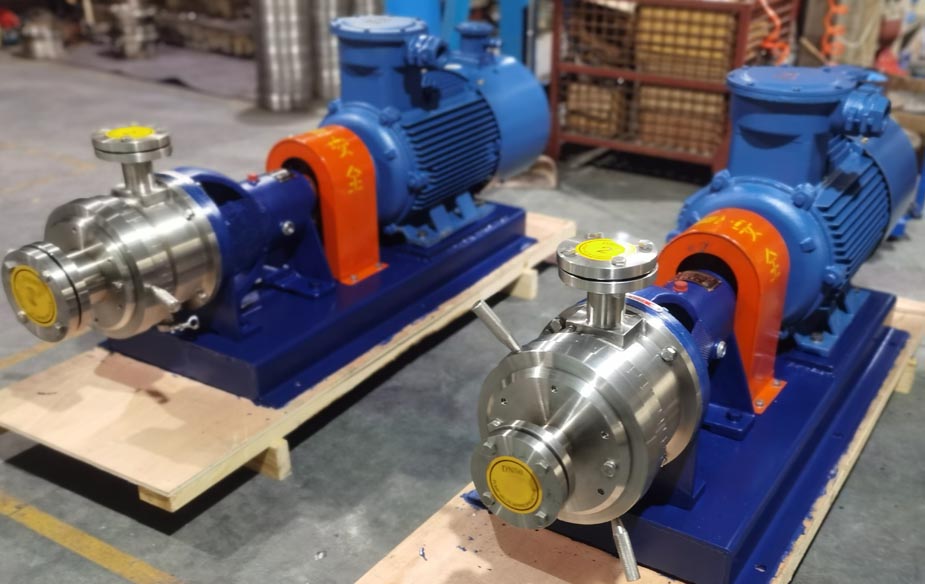
Working principle of pipe split grinding pump
This series of pumps is a multifunctional mechanical equipment for processing various materials such as fluids, colloids, and pastes, including wet ultrafine particle crushing, high shear, emulsification, dispersion, homogenization, stirring, mixing, depolymerization, and grinding. It has a wide range of applications and can replace and outperform stone mills, sand mills, ball mills, emulsifiers, shear dispersion pumps, homogenization pumps, emulsifiers, three roll machines, and tissue crushers in terms of work efficiency, as shown in Figure 1.
Real photos of various products. jpg
In this series of pumps, the functions are divided according to the internal structure: high-speed beating and mixing type, multi-functional colloid mill for grinding and beating type, and multi-functional grinder (pipeline type). The refining effect of colloid mill is generally weaker than that of high-pressure homogenizer for crushing soft drinks and other soft fluids, but it has strong adaptability to materials (such as high viscosity and large particles). Therefore, in many cases, it is used in the front of homogenizer or in high viscosity situations. Colloidal mills are often used for refinement when there are many solid substances.
The JP-W-F pump series is a split type grinding pump that is driven by a horizontal motor through a split transmission device and coupling to achieve wet grinding and other functions by high-speed rotation and complex force between the dynamic grinding disc and the matched static grinding disc. Equipment advantages: synchronous operation, pipeline connection, reasonable design, small size, good stability, automatic integration Compared with other traditional pipeline colloid mill equipment in the conventional market, such as the belt driven by the motor pulley, the main pulley reduces efficiency due to wear and slippage. In addition, if the belt pulley and pulley are prone to malfunction while the motor still operates inefficiently, it cannot be observed So the advantages of this pump compared to traditional belt driven colloid mills are obvious. And the gap between the fixed and rotating teeth can be adjusted. The processed material is pressurized by its own weight or external pressure (which can be generated by a pump) to generate a downward spiral impact force. When passing through the gap between the fixed and rotating teeth of the colloid mill, it is subjected to strong physical effects such as shear force, friction force, and high-frequency vibration, effectively emulsifying, dispersing, and crushing the material, achieving the effect of ultrafine crushing and emulsification of the material.
JP-WAD-F is a fourth generation pump, and the complete set of equipment includes: a transmission system device, a compensation device, which can flexibly adjust the spacing of the adjustment plate to emulsify fineness and prevent expansion, balance the pressure inside the container, an outlet check valve to prevent slurry reflux and internal stress generation, an inlet filter to filter and protect impurities in the slurry, a pump grinding system, a transmission device, and other functional device combinations. Its characteristics include easy operation, hygiene and environmental protection, energy saving and high efficiency, and long service life, thus achieving shock resistance, preventing impurities in processed materials to ensure material quality. It is also equipped with long-term normal operation and other performance colloid grinding pump fluid crushing equipment.
Improvement structure of split type coupling equipment: 1) The grinding system and motor are connected by a split type coupling; 2) Add a water blocking structure between the pump casing and the split type coupling; 3) When replacing the grinding disc, the adjustment disc can be disassembled without rotating it; 4) Import and export use movable installation connection method; 5) The grinding machine is made of chromium molybdenum alloy steel material. The complete set of equipment has been innovated and added in various aspects of technology, making it easy to operate and maintain, preventing motor burnout, and improving equipment performance and extending the service life.
The comprehensive performance of this series of pumps can be widely used in industries such as chemical, power, metallurgy, textile, petroleum, biochemistry, pharmaceuticals, building materials, coal, environmental protection, new energy, and new materials. Especially suitable for: titanium industry, essence, spice, medicine, medicine, petroleum, chemical industry, fine chemical industry, biological agents, plant protein, corn, animal protein, beer, food, explosives, universities, scientific research laboratories and other fields.
It can grind and transport fluids, colloids, and other slurries and pastes containing solid particles, as well as heavy medium transport. For example, the maximum allowable slurry weight concentration Cw for transportation is: titanium dioxide slurry ≤ 30%; White carbon black slurry ≤ 25%; Graphene black paste ≤ 30%; Modified silica slurry ≤ 25%; Coal slurry ≤ 45%; Slurry and heavy medium ≤ 60%.
Especially with our latest launch of the fourth generation JPW-F series grinding pump - titanium dioxide colloid mill, white carbon black beating pump - colloid homogenization grinder and other series, which are pioneering in China, our patented technology new products have been adopted and practically promoted by nearly hundreds of production enterprises and key laboratories and research institutes of universities at home and abroad, and have received high praise from experts.
3、 Types and structural characteristics of pumps
1. Type of JP-WAD grinding pump (multifunctional colloid mill)
The JP-WAD grinding pump series is divided into two categories, one is the horizontal coupled direct coupled single cooling colloid mill JM-W-AA, JP-W-AB, JP-W-AC; The other type is the horizontal coupled direct coupled improved colloid mill JP (JM) - AD-1, and the horizontal coupled direct coupled double cooled colloid mill JM (JP) AD-2; One type is JPWF grinding pump type, JPWF split transmission coupling grinding pump AD-F type. This manual provides instructions for the use of JPWF grinding pump type.
2. Structural characteristics of JP-WAD grinding pump F-type colloid mill
The entire set of equipment for the JP-WAD-F grinding pump combination colloid mill mainly consists of imported and movable inlet flanges (inlet short circuiting), inlet filters, compensators, outlet check valves, movable outlet flanges (outlet short circuiting), pump bodies (also known as shells, pump heads), grinding systems, transmission devices (split frame bodies), transition plates, shaft sleeves, bearings, bearing oil tanks, oil tank pressure plates, motors, machine bases and other main components.
① Pump body part
The pump head of JP-WAD-F grinding pump (multifunctional colloid mill) includes a pump casing, grinding discs (dynamic and static), and a shaft seal device. The pump head of the grinding device is fixedly connected to the transmission system using bolts. According to the needs, the outlet position of the pump can be installed and used by rotating six or eight different angles at 45 ° intervals.
The pump housing of JP-WAD-F grinding pump (multifunctional colloid mill) is made of stainless steel material, and is combined with grinding discs (dynamic and static grinding discs) to form the grinding system. The pump cavity is matched with the dynamic grinding disc of the grinding disc, which is threaded with the shaft. The materials of the dynamic and static grinding discs are configured according to the user's technical requirements, including high-speed alloy steel, chromium molybdenum alloy steel, special stainless steel, various types of stainless steel, etc.
② Transmission device part
The JP-WAD-F transmission device is a cylindrical structure. Thin oil lubrication type. The thin oil lubrication coupling transmission device is mainly composed of coupling split frame, oil tank cover, shaft, bearing box, bearing (pump head side, motor side), bearing cover (pump head side, motor side), nut, oil seal, water blocking plate, disassembly ring, fixing nut and other parts. The cylindrical split frame uses thin oil lubrication to lubricate and protect the normal rotation of the bearing shaft. It is mainly composed of split frame, bearing oil tank, shaft, bearing, bearing oil tank pressure plate, bearing cover, oil seal, water blocking plate, disassembly ring and other parts, as shown in Figure 2
6 Transportation. jpg
1. Imported flange 2. Imported filter 3 Filter cover 4. Pipeline channel 5 Compensator 6. Adjusting handle 7. Outlet check valve 8. Outlet short circuit 9. Water plate connector 10. Shaft 11. Split transmission device 12. Bearing thin lubricating oil box 13. Coupling 14. Protective cover 15. Motor 16. Machine base 17. Bearing cover oil seal 18 Bearing 19. Bearing 20 Bearing gland oil seal 21. Mechanical seal 22. Pump body 23 Moving grinding disc 24 Static grinding disc 25. Adjusting disc 26. Imported short circuit 27 Filter (hole) device
|
管线式胶体磨型号对照
|
流量L/H
|
转速rpm
|
线速M.s
|
功率kw
|
入/出口连接DN
|
|
企业标准
|
国际标准
|
|
JM-W65-2
|
CM2000/2
|
200
|
3000
|
23
|
2.2
|
DN25/DN15/直联式
|
|
JM-W80-2
|
CM2000/3
|
1000
|
3000
|
23
|
3
|
DN25/DN20/直联式
|
|
JM-W100-2
|
CM2000/4
|
2000
|
3000
|
23
|
5.5
|
DN32/DN25/直联式
|
|
JM-W120-2
|
CM2000/5
|
3000
|
3000
|
23
|
5.5
|
DN40/DN25/直联式
|
|
JM-W140-2
|
CM2000/6
|
4000
|
3000
|
25
|
7.5
|
DN50/DN32/直联式
|
|
JM-W140b-2
|
CM2000/8
|
5000
|
3000
|
25
|
11
|
DN50/DN32/直联式
|
|
JM-W180-2
|
CM2000/10
|
8000
|
3000
|
25
|
15
|
DN65/DN40/直联式
|
|
JM-W200-2/F
|
CM2000/20
|
15000
|
3000
|
25
|
22
|
DN80/DN50/分体式
|
|
JM-W250-2/F
|
CM2000/30
|
30000
|
3000
|
25
|
37
|
DN125/DN65/分体式
|
|
JM-W320-2/F
|
CM2000/40
|
50000
|
3000
|
25
|
45
|
DN150/DN100/分体式
|
|
JM-W400-2/F
|
CM2000/45
|
60000
|
3000
|
25
|
75
|
DN150/DN125/分体式
|
|
JM-W500-2/F
|
CM2000/50
|
80000
|
3000
|
25
|
90/110
|
DN200/DN150/分体式
|
|
注*jJM-W200-500-2F常规采用直联式-2,精密度高于分体式;企业标准的管线式胶体磨与国际标准分体式胶体磨的优点: 由电动机采用B35电机直联轴同心连接精密度高,高节能,体积小,管线简便等特性,同时流量可以被调节到更大允许量的10-20%。
|